
Free Sever's Disease Parent Guide
Does your child's heel hurt after running or playing sport?
Download the free Sever's Disease Parent Guide. Understand why heel pain is sidelining your child - and get a clear, week-by-week framework to help them work back towards running comfortably.
8-page PDF • Written by a physiotherapist • Free instant download
What you'll learn inside the free guide
- The 60-second heel-squeeze test to confirm it's Sever's
- Exactly how much sport to allow (without making it worse)
- The first 5 exercises to start today
- Footwear and heel-cup adjustments that can help within days
- Red flags that mean you should see a clinician
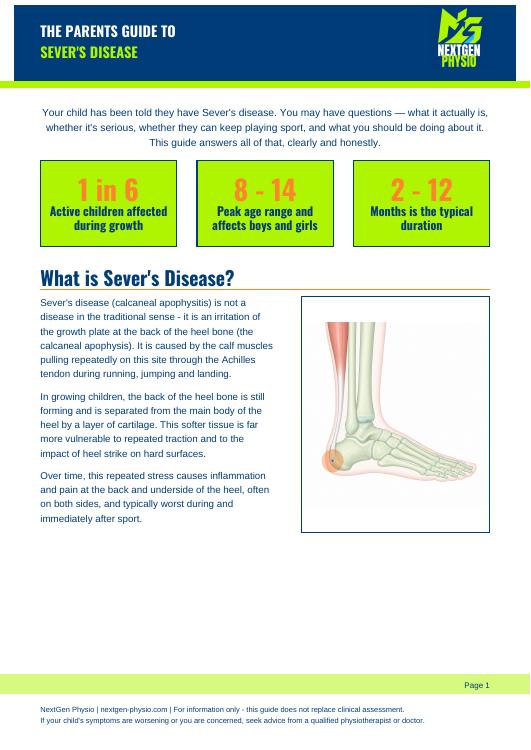
Sever's Disease can leave parents wondering what to do next
You don't need to work it out alone.
6-Week Recovery Framework
Want a structured plan to work through?
The free guide helps you understand what's going on. The £59 Sever's Disease Recovery Framework provides a structured six-week progression with load and pain guidance, exercise demonstrations and clear progression points.
Common questions from parents
Is the growth plate being damaged?
This is an irritation of the growth plate, not a break, and it is not known to cause lasting damage or affect how tall they end up. It settles as the area matures, and our job in the meantime is to keep them active without constant flare-ups.
Are we making it worse by letting them play?
Playing through severe limping tends to keep it flared up. Playing at a level where pain stays mild and settles within 24 hours is usually fine, and keeps them in the game while the calf and foot get stronger.
Everyone says just rest it, why hasn't that worked?
Rest calms it down, but nothing gets stronger while they sit still, so the pain often returns the week they go back. Reducing load and building calf and foot strength at the same time tends to hold up much better.
When should we get an assessment?
If you're unsure of the cause, speak to a physiotherapist or GP. Get prompt advice if there is severe pain, night pain, swelling or difficulty bearing weight.
Is this individual physiotherapy?
No. The free guide and the 6-Week Recovery Framework are general, template resources, not personalised physiotherapy or a diagnosis.
This information is general education, not a diagnosis or a substitute for an assessment by a qualified health professional.
Please read before you buy
- These are educational rehabilitation frameworks, intended for young athletes who have already been appropriately assessed and diagnosed by a qualified healthcare professional.
- They are not a substitute for individual clinical assessment, diagnosis or treatment, and they are not personalised to your athlete.
- A parent or guardian should be involved throughout, and should supervise the exercises.
- Stop and seek advice if symptoms get worse, or if any red flag appears: significant trauma, inability to weight bear, night pain, fever, unexplained weight loss, or a hot, swollen joint.
- Young athletes vary. Progress at a pace that suits the individual, and seek professional assessment if you are unsure whether this is suitable.
Start with the free guide
Get clarity on what's happening and what you can do next.
References
The research and guidance we drew on when writing this guide.
- Arnaiz, J., Piedra, T., de Lucas, E.M., et al. (2011) 'Imaging findings of lower limb apophysitis', American Journal of Roentgenology, 196(3), pp. W316-W325.
- Caine, D., DiFiori, J. and Maffulli, N. (2006) 'Physeal injuries in children's and youth sports: reasons for concern?', British Journal of Sports Medicine, 40(9), pp. 749-760.
- Frush, T.J. and Lindenfeld, T.N. (2009) 'Peri-epiphyseal and overuse injuries in adolescent athletes', Sports Health, 1(3), pp. 201-211.
- Gabbett, T.J. (2016) 'The training-injury prevention paradox: should athletes be training smarter and harder?', British Journal of Sports Medicine, 50(5), pp. 273-280.
- James, A.M., Williams, C.M. and Haines, T.P. (2013) 'Effectiveness of interventions in reducing pain and maintaining physical activity in children and adolescents with calcaneal apophysitis (Sever disease): a systematic review', Journal of Foot and Ankle Research, 6(1), p. 16.
- James, A.M., Williams, C.M. and Haines, T.P. (2016) 'Effectiveness of footwear and foot orthoses for calcaneal apophysitis: a 12-month factorial randomised trial', British Journal of Sports Medicine, 50(20), pp. 1268-1275.
- Lloyd, R.S., Cronin, J.B., Faigenbaum, A.D., et al. (2016) 'National Strength and Conditioning Association position statement on long-term athletic development', Journal of Strength and Conditioning Research, 30(6), pp. 1491-1509.
- Peck, D.M. (1995) 'Apophyseal injuries in the young athlete', American Family Physician, 51(8), pp. 1891-1895.