
Free Sinding-Larsen–Johansson Parent Guide
Does your child's knee hurt just below the kneecap?
Download the free Sinding-Larsen–Johansson Parent Guide. Help settle front-of-knee symptoms and support your young athlete back towards confident jumping and sprinting.
8-page PDF • Written by a physiotherapist • Free instant download
What you'll learn inside the free guide
- How to tell SLJ apart from Osgood–Schlatter
- The tendon-loading routine that builds resilience
- Smart load management for jumping sports
- Mobility work for tight quads and weak glutes
- Signs it's time for a personalised rehab plan
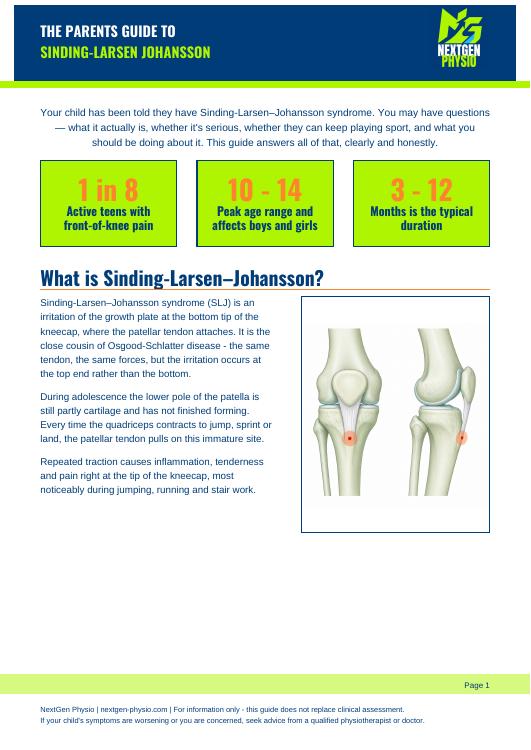
Sinding-Larsen–Johansson can leave parents wondering what to do next
You don't need to work it out alone.
6-Week Recovery Framework
Want a structured plan to work through?
The free guide helps you understand what's going on. The £59 Sinding-Larsen–Johansson Recovery Framework provides a structured six-week progression with load and pain guidance, exercise demonstrations and clear progression points.
Common questions from parents
Is this arthritis or long-term joint damage?
No. This is irritation of a growing attachment point, not joint wear, and it is not a forerunner of arthritis.
Why does it hurt on stairs and after sitting?
Both load the front of the knee, stairs through the tendon and sitting by holding the knee bent under tension. It is a sign the area is sensitised, not that something is slipping or tearing.
How do we stop it coming back every season?
Recurrence usually follows a jump in training volume without the strength to match. Keeping up thigh, hip and calf strength through the season is the most reliable protection we have.
When should we get an assessment?
If you're unsure of the cause, speak to a physiotherapist or GP. Get prompt advice if there is severe pain, night pain, swelling or difficulty bearing weight.
Is this individual physiotherapy?
No. The free guide and the 6-Week Recovery Framework are general, template resources, not personalised physiotherapy or a diagnosis.
This information is general education, not a diagnosis or a substitute for an assessment by a qualified health professional.
Please read before you buy
- These are educational rehabilitation frameworks, intended for young athletes who have already been appropriately assessed and diagnosed by a qualified healthcare professional.
- They are not a substitute for individual clinical assessment, diagnosis or treatment, and they are not personalised to your athlete.
- A parent or guardian should be involved throughout, and should supervise the exercises.
- Stop and seek advice if symptoms get worse, or if any red flag appears: significant trauma, inability to weight bear, night pain, fever, unexplained weight loss, or a hot, swollen joint.
- Young athletes vary. Progress at a pace that suits the individual, and seek professional assessment if you are unsure whether this is suitable.
Start with the free guide
Get clarity on what's happening and what you can do next.
References
The research and guidance we drew on when writing this guide.
- Arnaiz, J., Piedra, T., de Lucas, E.M., et al. (2011) 'Imaging findings of lower limb apophysitis', American Journal of Roentgenology, 196(3), pp. W316-W325.
- Gaida, J.E. and Cook, J. (2011) 'Treatment options for patellar tendinopathy: critical review', Current Sports Medicine Reports, 10(5), pp. 255-270.
- Ladenhauf, H.N., Seitlinger, G. and Green, D.W. (2020) 'Osgood-Schlatter disease: a 2020 update of a common knee condition in children', Current Opinion in Pediatrics, 32(1), pp. 107-112.
- Lloyd, R.S., Cronin, J.B., Faigenbaum, A.D., et al. (2016) 'National Strength and Conditioning Association position statement on long-term athletic development', Journal of Strength and Conditioning Research, 30(6), pp. 1491-1509.
- Neuhaus, C., Appenzeller-Herzog, C. and Faude, O. (2021) 'A systematic review on conservative treatment options for Osgood-Schlatter disease', Physical Therapy in Sport, 49, pp. 178-187.
- Peck, D.M. (1995) 'Apophyseal injuries in the young athlete', American Family Physician, 51(8), pp. 1891-1895.
- Rathleff, M.S., Winiarski, L., Krommes, K., et al. (2020) 'Activity modification and knee strengthening for Osgood-Schlatter disease: a prospective cohort study', Orthopaedic Journal of Sports Medicine, 8(4), 2325967120911106.
- van Ark, M., Docking, S.I., van den Akker-Scheek, I., et al. (2016) 'Does the adolescent patellar tendon respond to 5 days of cumulative load during a volleyball tournament?', Scandinavian Journal of Medicine and Science in Sports, 26(2), pp. 189-196.