

What is a growth plate fracture?
Near each end of a child's long bones sits a layer of cartilage called the growth plate, or physis. It is where new bone is laid down so the limb lengthens. Because cartilage is softer than the surrounding bone and stronger tendons around it, a force that would sprain an adult's ankle or wrist can instead break through a child's growth plate.
That is why an injury that looks minor on the pitch can still be a fracture. Growth plate injuries make up roughly a fifth to a quarter of all children's fractures, and they are most common around the wrist, ankle, knee and fingers, in the years either side of the growth spurt.
The reassuring part: the vast majority heal well and go on to grow normally. The reason clinicians take them seriously is that a small number can affect how the bone grows afterwards, and that risk is largely predicted by which type of fracture it is.
Why children are different, not just smaller
In an adult, ligaments tend to fail first. In a growing child, the growth plate is often the weakest link, so the same twist produces a fracture rather than a sprain. Any child with bony tenderness right at the end of a bone after an injury deserves an X-ray rather than an assumption of a sprain.
How do the five types differ?
Clinicians use the Salter-Harris classification, a numbering system from I to V, based on where the fracture line travels. It sounds technical, but the logic is simple: the more the fracture crosses the growth plate and the joint surface, the more careful the follow-up needs to be.
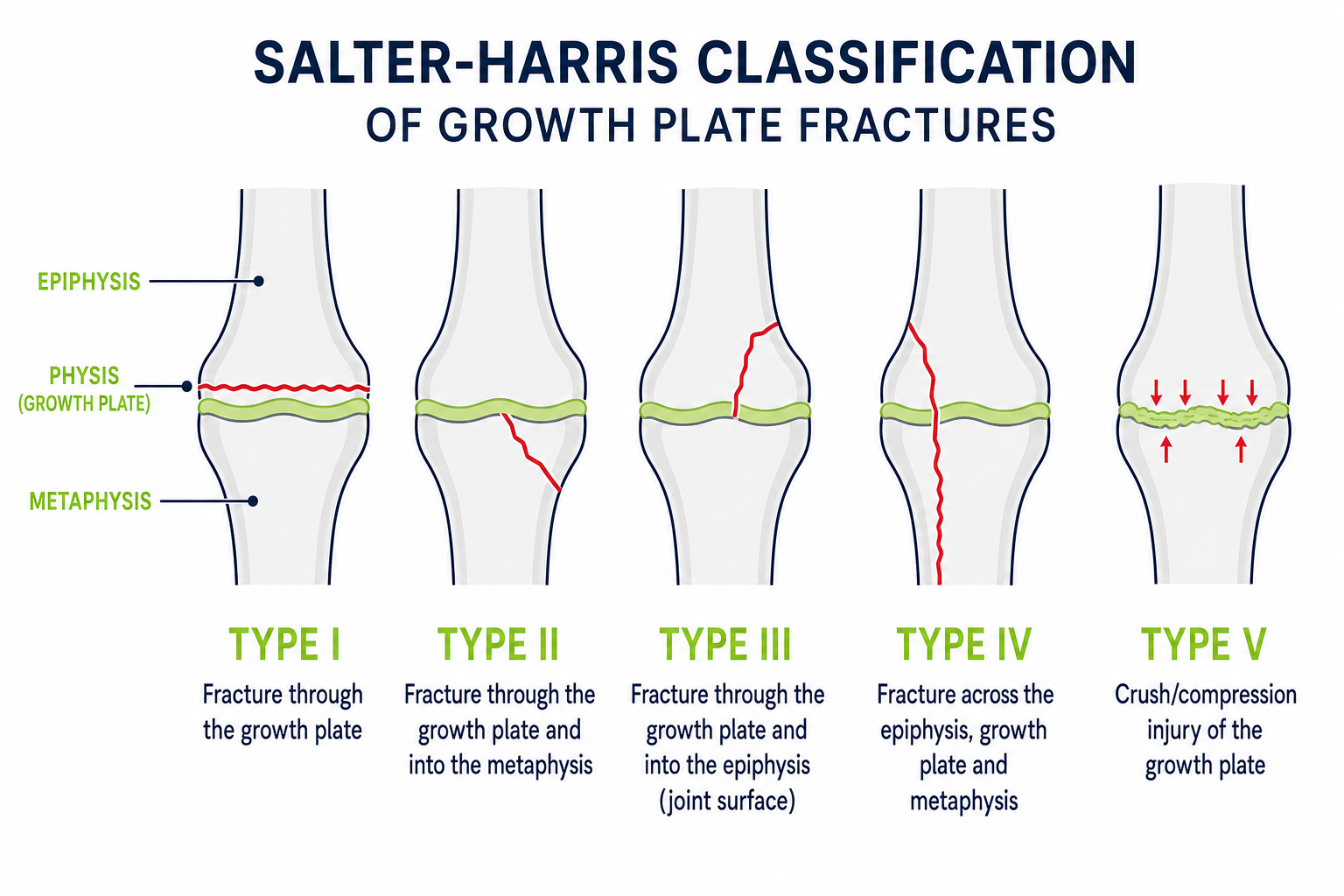
The Salter-Harris types. Type I runs straight through the plate; type V is a crush injury of the plate itself.
What does each type usually mean in practice?
The table below is a general guide to what parents can expect. Your child's own plan depends on the site, how displaced the bone is, their age and how much growth is left.
| Type | Where the fracture runs | How common | Typical management |
|---|---|---|---|
| Type I | Straight through the growth plate only | Around 5 to 10 percent | Cast or splint, often 3 to 6 weeks. Outlook usually very good. |
| Type II | Through the plate and up into the shaft side | The most common, roughly 70 to 75 percent | Realignment if needed, then cast. Growth is usually unaffected. |
| Type III | Through the plate and down into the joint surface | Around 7 to 10 percent | Often needs precise realignment, sometimes surgery, because the joint surface is involved. |
| Type IV | Across the shaft, the plate and the joint surface | Around 10 percent | Usually surgical fixation, with longer follow-up for growth. |
| Type V | A crush or compression of the plate itself | Under 1 percent | Hard to see early on, protected weight bearing, closest monitoring of growth. |
General patterns by type. Individual plans are set by the treating team.
How long does healing take?
Bone healing in children is fast. Most growth plate fractures are solid enough to come out of a cast in 3 to 6 weeks, sometimes 8 for larger bones or surgical cases. What takes longer is everything the cast caused: stiffness, muscle loss, altered movement patterns and, quite often, a wary child.
That gap is where physiotherapy matters. A wrist can be healed on X-ray and still be a long way from safe for gymnastics; an ankle can be pain free walking and still not tolerate landing from a jump. Return to sport is a capacity decision, not a calendar one.
Week 0
Diagnosis and protection
X-ray, realignment if required, then a cast, splint or boot. Pain and swelling settle over the first week or two.
Weeks 1 to 5
Healing phase
Bone knits. Keep the rest of the body working: general conditioning, the other limb, and gentle movement of joints outside the cast.
Weeks 4 to 7
Out of the cast, restoring movement
Regaining range of motion, walking normally, easing back into weight bearing. Stiffness is expected and improves quickly.
Weeks 6 to 12
Rebuilding strength and load tolerance
Progressive strength work, then hopping, landing, changes of direction and sport-specific drills as symptoms allow.
Months 3 to 6
Return to sport and growth follow-up
Full training once strength and confidence match the other side. Types III to V are reviewed for 12 to 24 months to check growth continues evenly.
A typical path after an uncomplicated growth plate fracture.
So what does physiotherapy actually do?
Physiotherapy does not speed up bone healing. What it does is make sure your child comes out of the injury as strong and capable as they went in, and that they are not carrying a weak link back into their sport.
- Keeps the rest of the body training while the injured limb is protected, so fitness and strength elsewhere do not fall away.
- Restores full joint range once protection ends, using graded movement rather than forced stretching.
- Rebuilds strength on both sides, since the uninjured limb also loses capacity during weeks of reduced activity.
- Reintroduces impact in stages: walking, then double-leg hopping, then single leg, then running, then cutting and landing.
- Rebuilds balance and control of the joint, which is commonly reduced after immobilisation and is a factor in repeat injury.
- Adds the confidence piece: a child who trusts the limb moves normally, and normal movement protects the joint.
- Sets clear return criteria, usually strength and hop or grip capacity within about 10 percent of the other side, plus pain-free sport-specific drills.
What about future growth?
The honest answer is that most children grow completely normally afterwards. The risk of a growth disturbance is low overall and concentrated in types III, IV and V, in fractures at high-risk sites such as around the knee, and in younger children who have more growing left to do.
If a part of the plate does close early, the limb can grow slightly unevenly or angle over time. This is why follow-up X-rays are arranged for the higher types, sometimes for a year or two, and why it is worth keeping those appointments even when everything feels fine. Picked up early, uneven growth is very manageable.
Lower concern (types I and II)
- Fracture stays out of the joint surface
- Cast or splint, then straightforward rehab
- Growth disturbance uncommon
- Follow-up often ends once healed and moving well
Closer monitoring (types III to V)
- Joint surface or the plate itself is involved
- Precise realignment, sometimes surgery
- Higher chance of a growth effect
- Planned reviews over 12 to 24 months
Two different follow-up conversations.
When should we get an injury checked?
Get it assessed the same day
Any obvious deformity, inability to bear weight or use the limb, tenderness pressed directly on the bone right at the end near a joint, marked swelling after a fall or twist, numbness or pins and needles, or a child who will not use the limb at all. Do not assume a sprain in a growing child; an X-ray settles it. Pain that persists beyond a week or two after a seemingly minor injury also warrants a look.