

What does peak height velocity mean?
Children do not grow at a steady rate. Growth speeds up through early puberty, hits a short, sharp peak, then slows down until it stops. That peak, the fastest few months of growing, is what clinicians call peak height velocity, or PHV. In everyday language, it is the middle of the growth spurt.
At the peak, a child can add somewhere between 7 and 12 cm in a year. Girls usually reach it around 11.5 to 12.5 years and boys around 13.5 to 14.5, though a two-year variation either side is completely normal. That is why two 13-year-olds in the same team can be at entirely different stages: one may have finished their spurt while the other has not started.
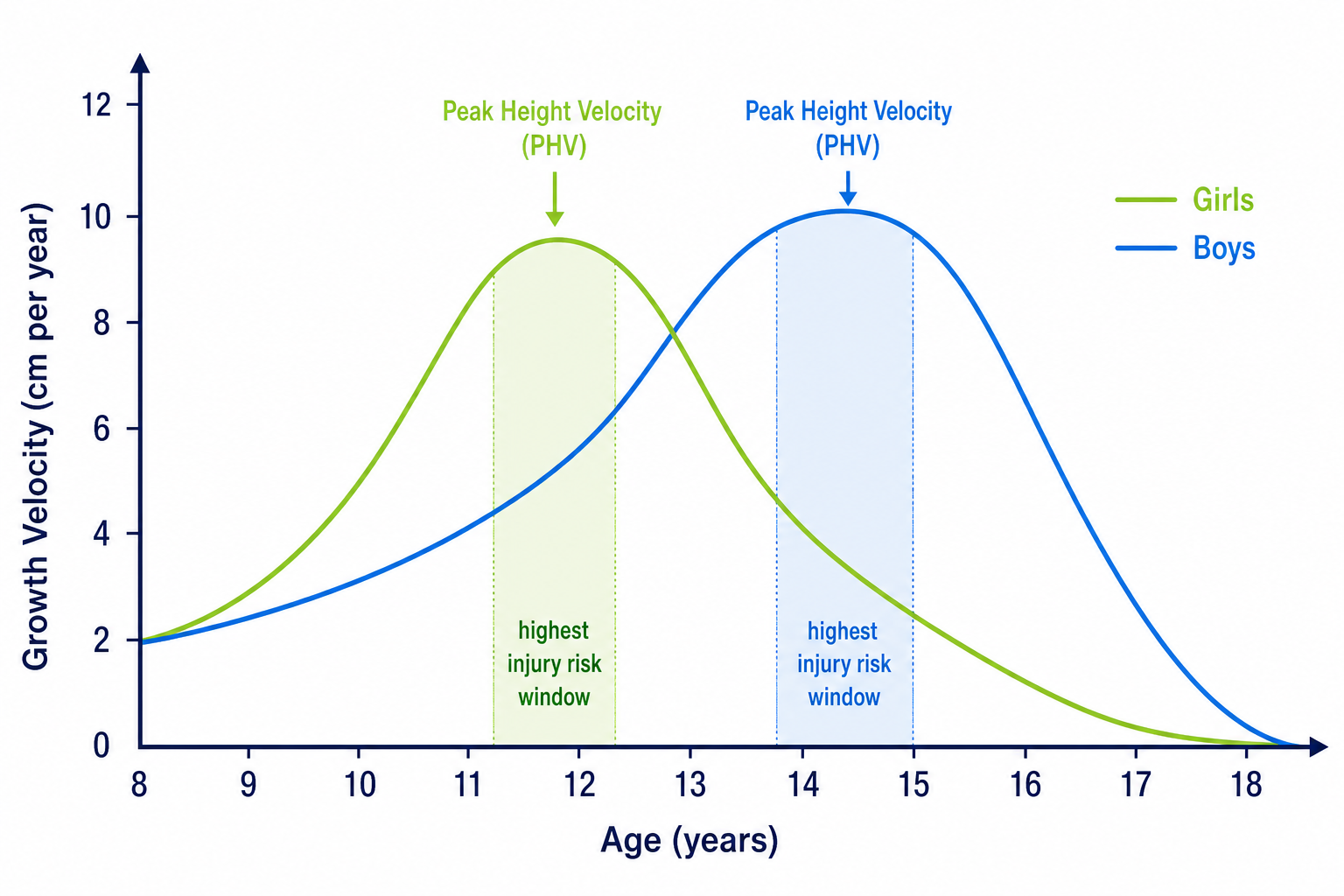
Growth velocity through adolescence. The peak is short, and girls reach it roughly two years before boys.
Why does the growth spurt matter for injuries?
During fast growth, bones lengthen before the muscles and tendons around them adapt. That leaves tendons temporarily under more tension and the growth plates working at full tilt, exactly when many children are also playing more sport as they move into bigger squads and longer seasons.
The result is a predictable cluster of problems. Osgood-Schlatter at the knee, Sever's at the heel, Sinding-Larsen-Johansson at the lower kneecap and growth-related back pain all peak in the months around PHV. None of them mean your child is fragile or should stop sport; they mean the current load is outpacing what the growing tissue can tolerate right now.
| What happens | What you may notice | What helps |
|---|---|---|
| Bones lengthen quickly | Tendons feel tight, heel or knee soreness after sport | Hold volume steady, manage jumping and sprinting loads |
| Growth plates are most active | Tenderness right on a bony bump | Reduce spikes in impact, keep strength work going |
| Limb proportions change | Clumsiness, awkward landings, slower feet | Coordination and landing drills, patience with technique |
| Higher energy demand | Tiredness, hunger, flat performance | More food and sleep, not more training |
| Strength lags behind height | Feels weaker despite getting taller | Keep resistance training in; strength catches up after the peak |
What changes during the spurt, and what it means for training.
How can I tell if my child is in it?
You do not need a clinic or a scan. Measuring height regularly is the single most useful thing a parent can do, and it takes two minutes.
- Measure standing height every 8 to 12 weeks, same time of day, shoes off, heels against a wall. Write it down.
- Work out the change per three months. More than roughly 3 cm suggests a fast-growth window.
- Watch for shoe size jumping, trousers becoming short, and a sudden change in sitting height.
- Other clues: increased appetite, needing more sleep, and a run of unexplained aches after normal training.
- Share the numbers with coaches. A squad that knows who is growing fastest can adjust sessions rather than guess.
3 cm
In 3 months suggests fast growth
7 to 12 cm
Possible gain in the peak year
12 to 18 months
Typical length of the risk window
Rough markers for the fastest growing phase.
What should change in their training week?
The instinct is often to stop everything or, at the other extreme, to push harder because a growing child looks more athletic. Neither works well. The aim during the spurt is to keep the good stuff and steady the load.
- Hold total weekly hours where they are rather than adding a new team or extra sessions.
- Keep an eye on the high-impact portion: jumping, sprinting, repeated changes of direction. That is the part worth capping first.
- Keep well coached strength training in. It does not harm growth plates and it helps growing tissue tolerate sport.
- Protect at least one full rest day and one lighter week every four to six weeks.
- Prioritise sleep, 8 to 10 hours, and enough food across the day; both are climbing in importance during a spurt.
- Expect temporary technique wobbles and coach movement quality rather than adding conditioning punishments.
- Where possible, group children by maturity rather than birth year for contact and heavy-landing sessions.
Will they lose out by easing off?
This is the question parents actually worry about. In practice, the children who keep progressing are the ones who stay available. A managed spurt with steady training beats a spurt full of stop-start soreness that costs half a season.
There is also an upside on the other side of the peak. After PHV, boys in particular become far more responsive to strength and power training, so the athlete who arrives there uninjured and technically sound gains the most. Easing volume for a few months is an investment, not a setback.
Managed well
- Height tracked, coach informed
- Volume held steady through the peak
- Strength and landing work maintained
- Mostly available, steady progress after the peak
Unmanaged
- New teams and sessions added mid-spurt
- Repeated knee or heel flare-ups
- Weeks off, then a rushed return
- Season fragmented, confidence knocked
Two ways a growth spurt can go.
When should we get pain checked?
Worth a professional assessment
Pain that wakes your child at night, a limp lasting more than a few days, hip or groin pain with restricted movement, joint swelling, pain that is getting worse week on week, pain after a single significant injury, or pain alongside unexplained weight loss or feeling unwell. Growth spurt aches usually settle with load changes; anything that does not follow that pattern deserves a look rather than a wait.